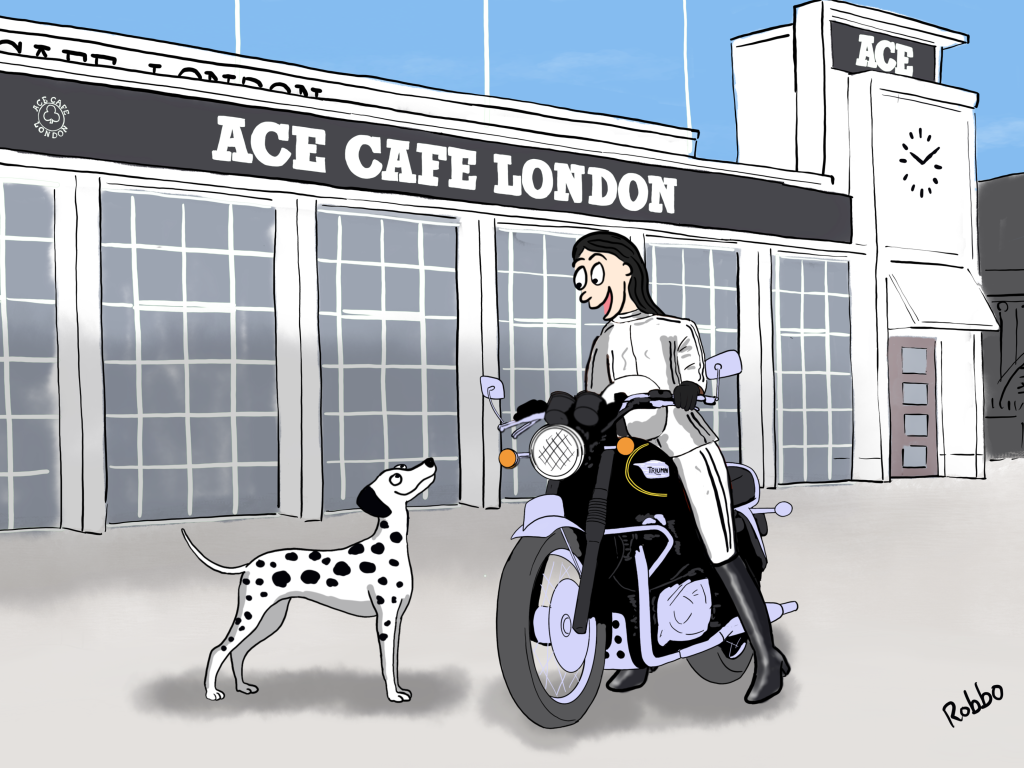

Ian Pegg
3 months ago


Some motorcycles are merely transport. Triumphs are something else entirely.
There’s a reason Steve McQueen chose a Triumph for that fence jump in The Great Escape. There’s a reason Marlon Brando’s crowd in The Wild One rode Triumphs. There’s a reason the name has survived since 1902 through wars, economic crises, bankruptcy, and rebirth to remain one of motorcycling’s most recognized and respected names.
Triumph motorcycle cartoons celebrate all of that. The heritage. The rebellion. The engineering. The culture that surrounds these machines and the people who ride them.
My grandfather owned numerous British motorcycles over the years. Whether one of them was a Triumph I can’t say for certain – that’s information lost to time unfortunately. But the fact that it’s entirely plausible tells you everything about Triumph’s place in British motorcycling culture. If someone rode British bikes, there’s a reasonable chance a Triumph was involved somewhere along the way.
You can’t talk about Triumph without talking about the Bonneville.
Named after the Bonneville Salt Flats in Utah, where Johnny Allen set a land speed record on a Triumph-engined streamliner in 1956, the Bonneville became Triumph’s most iconic model. It arrived in 1959 and immediately became everything a motorcycle should be – quick, characterful, beautiful, and accessible enough that ordinary riders could actually own one.
The Bonneville suited its era perfectly. Café racers bolted on parts, tuned engines, raced between café to café. Rockers claimed it as their own. Americans imported them in huge numbers. Steve McQueen rode one and made the whole world want one.
That cultural moment – British twin-cylinder engine, parallel twin configuration, classic styling – defined what a motorcycle looked like for decades. Everything that followed either referenced the Bonneville or deliberately avoided referencing it.
The Bonneville name has never gone away. Modern Triumph Bonnevilles continue the tradition with contemporary engineering wrapped in classic proportions. The DNA remains recognizable across sixty-plus years of production.
Triumph motorcycle cartoons of Bonnevilles capture that heritage instantly. The classic proportions. The parallel twin. The name that carries so much cultural weight.
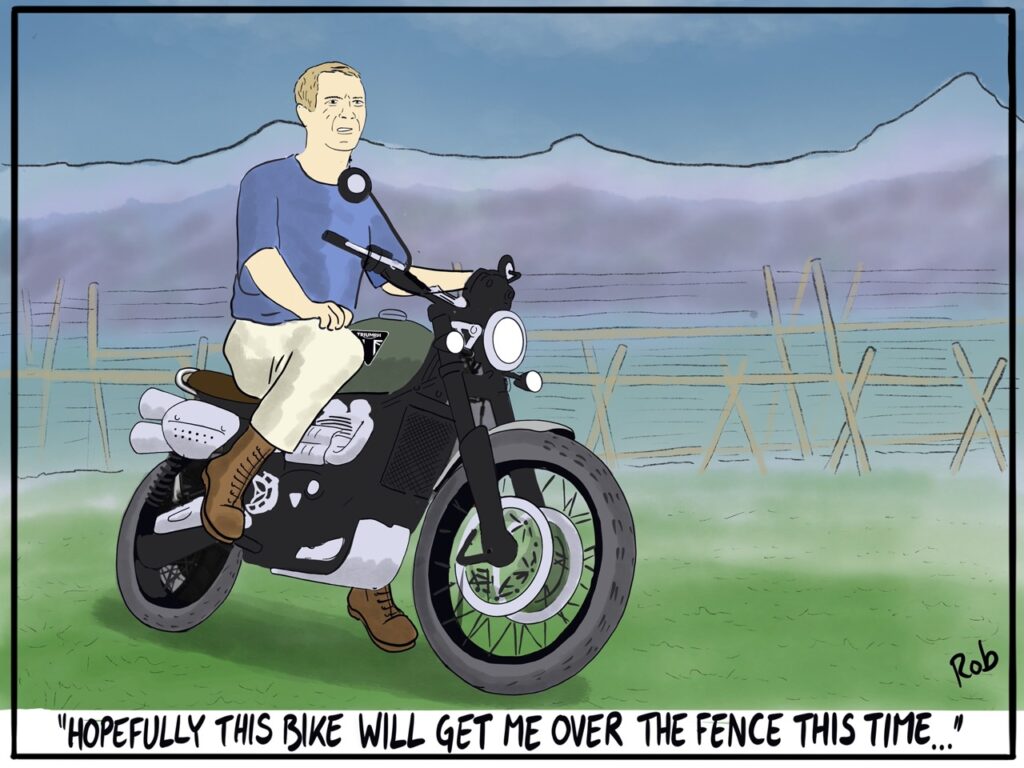
The fence jump scene in The Great Escape is one of cinema’s great motorcycle moments.
McQueen playing Hilts – the Cooler King – riding what was officially a German motorcycle but was actually a Triumph TR6 Trophy modified to look the part. McQueen did most of his own stunts. The fence jump itself was performed by his friend Bud Ekins, but McQueen rode everything else.
The connection between McQueen and Triumph ran deeper than one film. He was a genuine motorcycle enthusiast who raced seriously and understood bikes properly. His endorsement wasn’t celebrity association – it was authentic appreciation from someone who knew what he was talking about.
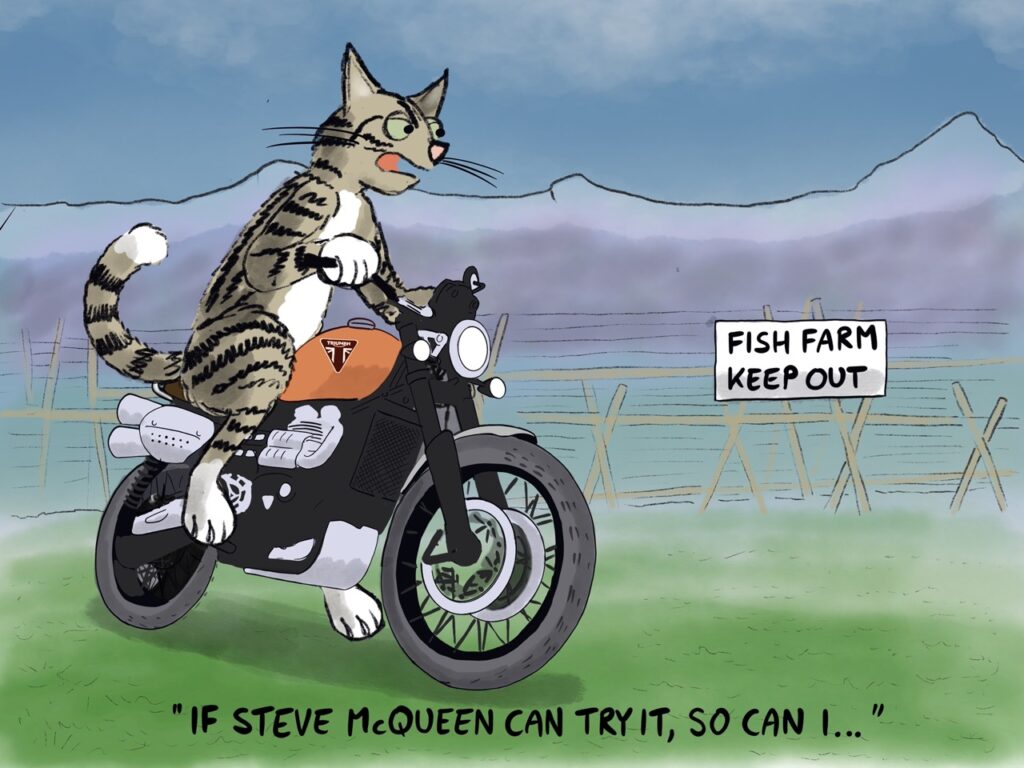
For Triumph motorcycle cartoons, that McQueen connection offers brilliant visual possibilities. The Great Escape aesthetic – that determination, that freedom-seeking spirit – captures something fundamental about why people ride motorcycles in the first place.
Triumph’s original home was Coventry, where the company built motorcycles from 1902 onwards. The postwar years were Triumph’s golden era – the Speed Twin, the Thunderbird, the Bonneville. British motorcycles dominating world markets.
Then Japanese manufacturers arrived with better reliability and lower prices. British motorcycle industry collapsed. Triumph went bankrupt in 1983. The original company ceased production.
The story could have ended there. It didn’t.
John Bloor bought the Triumph name and spent years quietly developing an entirely new company in Hinckley, Leicestershire. New factory, new designs, new engineering – but the same name and respect for heritage. Production restarted in 1990.
The Hinckley Triumph succeeded where the revival could easily have failed. The Speed Triple, Tiger, Daytona, Thruxton, Thunderbird – modern motorcycles with genuine Triumph character. Not nostalgia exercises. Proper motorcycles that happened to carry one of motorcycling’s greatest names.
That revival story deserves celebrating. A British motorcycle brand that should have disappeared in 1983 and instead emerged stronger, more focused, and more respected than ever.
Modern Triumph covers remarkable variety while maintaining coherent identity.
The Bonneville family continues classic styling with modern reliability. T100, T120, Thruxton, Street Twin, Street Scrambler – variations on the parallel twin theme that started in 1959.
The Speed Triple arrived in 1994 and created the naked streetfighter category. Aggressive, powerful, purposeful. The opposite end of the spectrum from Bonneville nostalgia – pure modern performance.
The Tiger adventure bikes serve riders who want to go further, across more varied terrain. Practical, capable, thoroughly modern.
The Daytona sports bikes demonstrated Triumph could compete with Italian and Japanese manufacturers on pure performance terms.
Classic pre-Hinckley Triumphs have their own devoted following. Pre-unit Bonnevilles, Thunderbirds, Tigers, Tropics – the original machines that created the legend. These are the motorcycles that informed everything that followed.
Triumphs are visually distinctive cartoon subjects. The classic parallel twin configuration. The proportions that look right from every angle. The badges that carry instant recognition.
Triumph motorcycle cartoons capture what photographs sometimes miss. The character of a specific machine. The history of a particular bike and its owner. The culture surrounding these motorcycles – the cafes, the rallies, the community of riders who understand what Triumph means.
Classic Triumphs especially reward cartoon treatment. Those period details. The chrome. The proportions that defined what motorcycles looked like. The connection to an era when British engineering led the world.
Modern Triumphs work brilliantly too. The Speed Triple’s aggressive stance. The Tiger’s adventure-ready character. The Bonneville’s contemporary take on classic proportions.
Tell me about your Triumph. Send photos – lots of them if you’ve got them. Classic Bonneville you’ve owned for years? Modern Speed Triple that’s your daily ride? Pre-unit machine you’ve restored? Let me know what you’d like to capture. We’ll chat about your vision, what matters most, and what makes you grin every time you hear that engine.
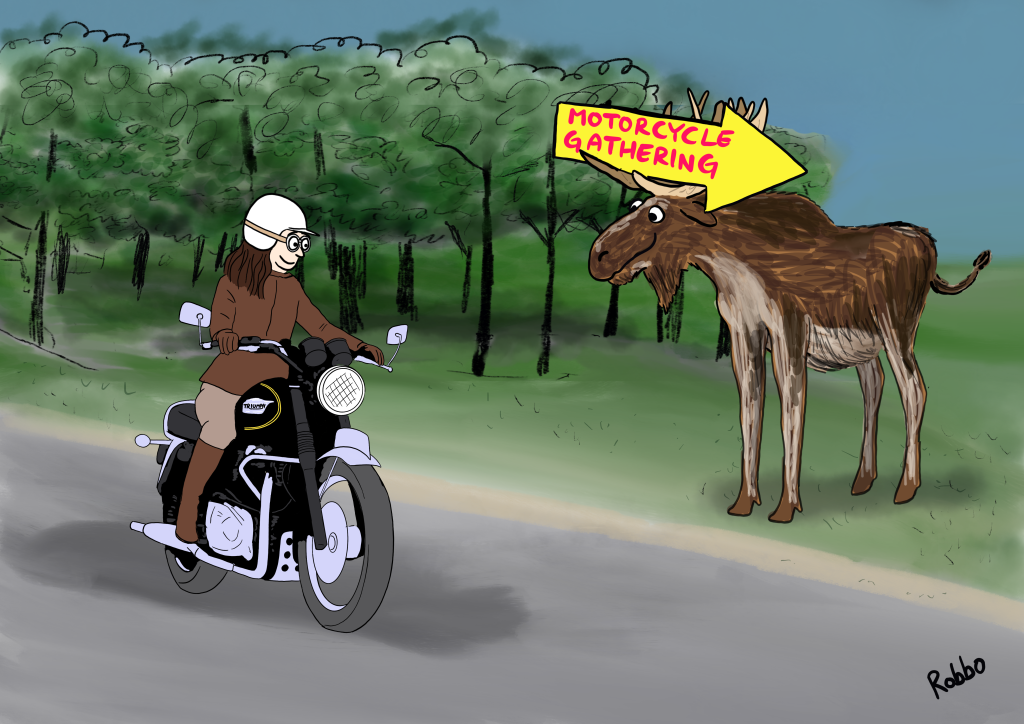
This is where the fun starts. You’ll see your Triumph come to life in sketch form, then refined illustration. I’ll show you different approaches – maybe one version has you on a favourite road, another at a Triumph gathering surrounded by fellow enthusiasts, a third capturing a specific moment that matters to you. Watch your photos and stories transform into something unique.
Once it’s done, your finished Triumph motorcycle cartoon is yours – ready to display, share with the Triumph community, or give as a gift to someone who totally gets the obsession. Not just any Triumph. Yours. With your history, your character, your connection to one of motorcycling’s greatest names.
Send everything you’ve got. Side profiles work brilliantly for showing your Triumph’s proportions and details. Three-quarter views capture character and stance. Detail shots help me nail specific features – tank badges, engine details, those particular touches that make your Triumph yours. Phone photos are absolutely fine.
Absolutely. Café racer modifications, custom exhausts, period accessories, restoration details – whatever makes your Triumph specifically yours gets captured. Modifications tell your story.
Yes! Favourite roads, rally locations, outside your house, iconic locations with Triumph connections. Send photos or describe what you’re picturing. We’ll make it work.
Definitely. You on the bike looking properly pleased with yourself. A passenger. Your dog looking thrilled about the whole experience. Personal touches transform motorcycle cartoons from “nice picture” to “that’s us, that’s our story.”
Most Triumph motorcycle cartoons take about a week from initial contact to finished artwork. Rush needed for a birthday or special occasion? Just ask.
Whether you’re riding a classic Bonneville that connects you directly to motorcycling’s golden era, a modern Speed Triple that represents Triumph’s contemporary excellence, a pre-unit machine you’ve lovingly restored, or you’re commemorating a family member’s motorcycling history that may or may not have included a Triumph but almost certainly did – let’s create something that captures it properly.
It’s not just the engine and the chrome. It’s the story those machines tell. The heritage connecting every Triumph back to Coventry and forward to Hinckley. The culture surrounding these motorcycles. The riders who chose Triumph when they could have chosen anything.
Triumph motorcycle cartoons aren’t just drawings of motorcycles. They’re illustrations of freedom, heritage, and that rebellious spirit that made Steve McQueen choose a Triumph for the most iconic motorcycle scene in cinema history.
Get in touch. Let’s create your Triumph motorcycle cartoon and celebrate what makes your connection to the name uniquely, unmistakably yours.
Triumph Steve McQueen
Triumph Scrambler